
 Apple Podcasts

 Spotify

 iHeartRadio

 Amazon Music
 Pandora
 TuneIn
How to Build a High-Performing Team Without Burning People Out
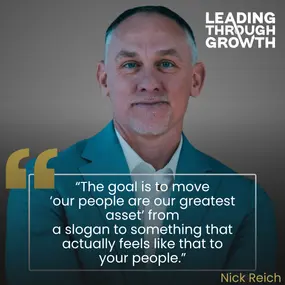
If building a high-performing team means constantly pushing people harder and harder, eventually something's going to break. But what if the best teams don't choose between high standards and caring for their people?
In this episode of Leading Through Growth, Tony Sanders sits down with Nick Reich, author of Every Player is Bigger Than the Program, to flip the script on one of the most common leadership philosophies in sports and business: "no player is bigger than the program."
Nick believes that phrase is often code for "no player is bigger than me." And he's spent years proving that people-first leadership isn't a softer way to lead — in many ways, it's actually harder.
Drawing from his experience building a high school basketball program from scratch that went on to win a state championship, Nick shares what it takes to move "our people are our greatest asset" from a slogan on the wall to something people actually feel and experience every day.
The conversation covers how to create clarity and connection, hold people accountable without burning them out, remove barriers to performance, and develop a culture where people know exactly what winning looks like. Nick also opens up about his own journey — from being kicked off his high school basketball team and arrested in college to becoming a school social worker and coach who gave second chances because he never got one himself.
This isn't about lowering standards or avoiding accountability. It's about understanding that high expectations without high care is the missing piece — and that the strongest leaders combine both.
What you'll learn:
- Why "no player is bigger than the program" is often about ego, not excellence
- How to operationalize people-first leadership without sacrificing performance
- The People-First Playbook framework: starting with purpose, creating direction and connection, and driving excellence
- Why high expectations and high accountability require clarity, not just consequences
- How to balance second chances with team health when individual needs conflict with collective success
- The difference between seeing people as numbers on a spreadsheet and recognizing their humanity
- Why people want to be pushed and held accountable — when it's done with kindness and respect
- How to keep the bar high and visible so it's not a moving target
If you're trying to build a team that performs at a high level without burning people out along the way, this conversation will give you a new way to think about leadership, accountability, and what it actually means to put people first.
LinkedIn: https://www.linkedin.com/in/nick-reich05/
Book: https://www.amazon.com/dp/B0GJYJ3TJX?ref=ppx_yo2ov_dt_b_fed_asin_title
Guest: Nick Reich, Author of Every Player is Bigger Than the Program
Chapters
- 00:00:00 Intro
- 00:01:52 Flipping the Script: Why Every Player IS Bigger Than the Program
- 00:05:01 Moving Beyond Slogans: Making People Your Greatest Asset
- 00:08:41 The People-First Playbook: Starting with Purpose
- 00:10:32 From Rock Bottom to Purpose-Driven Leadership
- 00:12:47 Second Chances and Accountability: The Balance Every Leader Must Strike
- 00:14:12 The Cancer in the Locker Room: When Individual Needs Conflict with Team Health
- 00:14:54 High Expectations Without High Care: The Missing Piece
#PeopleFirstLeadership #HighPerformance #Accountability #LeadershipDevelopment #LeadingThroughGrowth
WEBVTT
1
00:00:00.428 --> 00:00:03.790
So many coaches say no player is bigger than the program.
2
00:00:04.010 --> 00:00:07.551
What the coach is really saying is no player is bigger than me.
3
00:00:08.372 --> 00:00:13.974
If building a high performing team means constantly pushing people harder and harder, eventually something's going to break.
4
00:00:14.554 --> 00:00:19.717
But what if the best teams don't choose between high standards and caring for their people?
5
00:00:20.177 --> 00:00:29.001
The goal is to move our people are our greatest asset from a slogan to something that actually feels like that to your people.
6
00:00:29.621 --> 00:00:34.626
When your people don't feel that and experience that, I think that actually makes things worse.
7
00:00:34.666 --> 00:00:36.187
My guest today is Nick Reich.
8
00:00:36.207 --> 00:00:42.914
He's the author of Every Player is Bigger Than the Program, and he believes people-first leadership isn't a softer way to lead.
9
00:00:43.214 --> 00:00:44.976
In many ways, it's actually harder.
10
00:00:45.196 --> 00:00:50.241
It's easier to just build a wall up, and that gives me a little bit of distance.
11
00:00:50.681 --> 00:00:54.603
between protecting myself and you as a human, right?
12
00:00:54.623 --> 00:00:57.245
Because then you're just a number on a spreadsheet.
13
00:00:57.745 --> 00:01:11.053
In this conversation, we talk about what it actually takes to build a high-performing team, from creating clarity and connection to holding people accountable, removing barriers to performance, and developing a culture where people know exactly what winning looks like.
14
00:01:11.293 --> 00:01:13.355
I believe people want to be pushed.
15
00:01:13.535 --> 00:01:16.938
People want to be held accountable when it's done with kindness and respect.
16
00:01:17.338 --> 00:01:20.561
When you can continue to raise the bar, but you keep it visible.
17
00:01:20.941 --> 00:01:23.063
When they know it's not a moving target.
18
00:01:24.635 --> 00:01:30.578
Nick also shares lessons from building a basketball program from scratch that eventually won a state championship.
19
00:01:31.118 --> 00:01:37.542
And why he believes the strongest leaders combine high expectations with genuine care for the people they're leading.
20
00:01:37.782 --> 00:01:43.905
If you're trying to build a team that performs at a high level without burning people out along the way, then this conversation is for you.
21
00:01:44.125 --> 00:01:47.187
This is Leading Through Growth featuring Nick Reich.
22
00:01:52.057 --> 00:01:54.858
Nick, there's a tension in the title of your book.
23
00:01:54.878 --> 00:01:55.939
I have the book right here.
24
00:01:57.320 --> 00:01:59.261
Every player is bigger than the program.
25
00:01:59.521 --> 00:02:06.004
You and I both grew up in sports, and we know that this is the exact opposite of what your coach would tell you.
26
00:02:06.284 --> 00:02:09.826
In fact, you would hear, you know, no player is bigger than the program.
27
00:02:09.866 --> 00:02:17.150
So I'm wondering what about that old philosophy made you want to kind of turn that on its head and present it in a new way?
28
00:02:18.210 --> 00:02:19.551
Yeah, I mean, you're right, Tony.
29
00:02:19.631 --> 00:02:24.394
I've heard so many coaches say no player is bigger than the program.
30
00:02:24.414 --> 00:02:34.040
And one of the things that always struck me with that was oftentimes, not across the board, but oftentimes what the coach is really saying is no player is bigger than me.
31
00:02:34.740 --> 00:02:34.960
Right.
32
00:02:35.100 --> 00:02:36.540
I'm I'm the program.
33
00:02:36.901 --> 00:02:37.941
It's hierarchy.
34
00:02:38.301 --> 00:02:39.601
Like get in line.
35
00:02:39.941 --> 00:02:47.723
Like there's so much of that that comes back to the coach's ego, in my opinion, that, you know, and this is not I talk all the time.
36
00:02:47.763 --> 00:02:50.784
It's not a book that's anti program and anti system.
37
00:02:51.224 --> 00:02:53.665
It's a book that is pro prioritization.
38
00:02:54.285 --> 00:03:13.295
And for me, it is about the people in our systems and in our programs that should be the priorities, whether that's on our high school basketball team or our organizations, that we act like the kids in this case, the employees in our companies are there to serve the brand.
39
00:03:13.335 --> 00:03:17.538
And I just believe it's the opposite, that we're there to serve the people.
40
00:03:18.198 --> 00:03:29.242
And those people within those systems and within those programs are going to take us farther, faster than, you know, when we approach it from the standpoint that no player is bigger than the program.
41
00:03:29.302 --> 00:03:32.443
And it was certainly a philosophical piece for me.
42
00:03:33.603 --> 00:03:42.926
But a few years after winning state and actually in 2015 was the first time there was an article in the Indy Star that they asked me.
43
00:03:42.986 --> 00:03:46.107
And I said, yeah, like for me, every player was bigger than the program.
44
00:03:47.107 --> 00:03:49.448
And so that was really important to me then.
45
00:03:50.208 --> 00:04:03.692
And when the book came around to be able to share some of the story, as well as the leadership lessons learned along the way, it is a long title in a lot of ways, but it was one that was really important to me to be the title of the book.
46
00:04:04.778 --> 00:04:09.881
I love the title of the book because it is one that stops you in your tracks and you're like, wait a minute, what does that mean?
47
00:04:09.941 --> 00:04:11.222
Or how does that actually work?
48
00:04:11.242 --> 00:04:20.028
I'm thinking about someone listening to this podcast and their CHRO, Chief People Officer, head of talent, and they believe in this, right?
49
00:04:20.048 --> 00:04:23.771
Like if you were to say to them, like, hey, every player is bigger than the program.
50
00:04:23.791 --> 00:04:25.332
Like, yes, our people matter so much.
51
00:04:25.712 --> 00:04:27.133
I think where they get hung up.
52
00:04:27.793 --> 00:04:38.118
is I now have to go sell my CEO or my COO on this mindset or this philosophy because one of the things this philosophy generates is, like you said, prioritization.
53
00:04:38.658 --> 00:04:39.719
Where do we invest?
54
00:04:39.999 --> 00:04:41.039
How do we invest?
55
00:04:41.119 --> 00:04:42.420
What do we prioritize?
56
00:04:43.120 --> 00:04:48.503
What would you say to them or what would you arm them with to go have that conversation because –
57
00:04:49.163 --> 00:04:54.650
The CEO is going to say, no, the profit is the program and nobody's bigger than the profit, right?
58
00:04:54.670 --> 00:04:58.656
We got to make sure that everybody is here to drive profit.
59
00:04:59.056 --> 00:05:00.038
So what would you say to that?
60
00:05:01.020 --> 00:05:14.586
Yeah, I think you mentioned one of the things that we talk a lot about is the goal is to move our people are our greatest asset from a slogan to something that actually feels like that to your people.
61
00:05:15.227 --> 00:05:15.447
Right.
62
00:05:15.467 --> 00:05:22.570
Because I suspect that there's a lot of, you know, these platitudes hanging on the wall that say our people are our greatest asset.
63
00:05:22.830 --> 00:05:26.492
And if you ask the employees in the company, they may not actually feel that way.
64
00:05:27.172 --> 00:05:29.534
So that's the first part of your question.
65
00:05:29.594 --> 00:05:33.577
The second part is absolutely we are there to drive revenue.
66
00:05:33.598 --> 00:05:34.879
We are there to grow the business.
67
00:05:35.299 --> 00:05:42.585
I think part of it is when we are able to lead this way, which is not an easier or a softer way to lead.
68
00:05:42.605 --> 00:05:50.552
I think it's a much more difficult way to engage, to lead with intention, to really focus on developing people that,
69
00:05:51.152 --> 00:06:02.562
There is data that shows clearly for a very long period of time that those organizations are going to have increased retention, lower turnover, higher revenue.
70
00:06:02.582 --> 00:06:04.083
It is about the profit.
71
00:06:04.243 --> 00:06:05.644
It is about growing the business.
72
00:06:05.744 --> 00:06:15.392
And I believe this is the fastest way for us to get to sustainable long-term profit and success for our organizations.
73
00:06:16.233 --> 00:06:21.375
And many of the things that we're advocating for, even in the book, are not resource intensive.
74
00:06:21.415 --> 00:06:28.858
They're not things that we're going to the CEO saying, we need to invest six figures in this, that, or the other program.
75
00:06:28.898 --> 00:06:38.862
What it's saying is there are very explicit things that we can learn to do as leaders, most of which don't cost a lot of money, but they do take time and intentionality.
76
00:06:40.056 --> 00:06:44.798
I'm looking at the subtitle of your book, A People First Playbook for Building High-Performing Teams.
77
00:06:45.199 --> 00:06:53.643
It sounds like what you're saying is when companies say our people are our greatest advantage, our biggest asset, or all these things, it sounds good.
78
00:06:53.683 --> 00:06:58.725
It becomes a good bumper sticker or something to hang on the wall, but they don't really operationalize it.
79
00:06:58.746 --> 00:07:00.787
And this book helps them operationalize it.
80
00:07:00.847 --> 00:07:01.567
Is that accurate?
81
00:07:01.847 --> 00:07:03.769
It's certainly part of the goal, Tony.
82
00:07:03.869 --> 00:07:06.492
I think some of that is you're right.
83
00:07:06.552 --> 00:07:11.097
When we explicitly say, you know, our people are our greatest asset.
84
00:07:11.217 --> 00:07:11.458
Right.
85
00:07:11.998 --> 00:07:20.347
When your people don't feel that and experience that, I think that actually makes things worse in your culture when people see that on the wall.
86
00:07:20.387 --> 00:07:22.509
But that is not my day to day experience.
87
00:07:23.230 --> 00:07:38.763
And so, so much of this comes back to how do we drive a return on humanity to just see and recognize the people in our companies and the people on our teams across sectors, across organizations, across sports.
88
00:07:39.223 --> 00:07:48.586
To be able to say that these are humans having a human experience that are experiencing things inside of my place of business that impacts them outside.
89
00:07:48.746 --> 00:07:53.648
And they're experiencing things outside of my place of business that impact our work.
90
00:07:54.108 --> 00:07:55.348
How do we recognize that?
91
00:07:55.428 --> 00:07:56.389
How do we honor that?
92
00:07:56.709 --> 00:08:00.530
And how do we think about helping each person grow tremendously?
93
00:08:00.570 --> 00:08:07.716
towards the end result of increasing our team cohesion, increasing our organizational success.
94
00:08:07.736 --> 00:08:10.279
You know, you want to win basketball games.
95
00:08:10.519 --> 00:08:12.140
That is the goal, right?
96
00:08:12.300 --> 00:08:16.324
And it's no, you want to have your best quarterly earnings reports.
97
00:08:16.664 --> 00:08:22.469
That is the goal, but we often focus on the outcome as being like the end result.
98
00:08:22.830 --> 00:08:26.313
And the real work is all of the things that are going to get us there.
99
00:08:26.873 --> 00:08:28.955
And that's where the work happens.
100
00:08:28.995 --> 00:08:30.297
That's where the growth happens.
101
00:08:30.317 --> 00:08:36.383
And that's where the investment in your people needs to happen to be able to get you to those goals.
102
00:08:36.423 --> 00:08:40.688
So we just had a shift to make sure that we're prioritizing and focusing on the right thing.
103
00:08:41.795 --> 00:08:42.335
I love that.
104
00:08:42.816 --> 00:08:44.737
Can we walk through the framework?
105
00:08:44.757 --> 00:08:46.659
Do you mind doing if we can do that?
106
00:08:46.879 --> 00:08:47.359
Okay.
107
00:08:47.619 --> 00:08:49.521
So I have it in front of me here.
108
00:08:49.801 --> 00:08:52.663
The first thing that I see is purpose.
109
00:08:53.323 --> 00:08:57.787
Why is starting with purpose important to having a high performing team?
110
00:08:58.842 --> 00:09:08.191
So one of the things that I think a lot about is there's, and purpose is multifaceted, like many of the things I think within the playbook is one, it starts with me.
111
00:09:08.911 --> 00:09:12.114
I think everything starts with me as an individual leader.
112
00:09:12.334 --> 00:09:18.460
I have to be very clear on my why, on my core values, on my non-negotiables values.
113
00:09:19.060 --> 00:09:25.767
on how I want to show up as a leader because we so often are responding to things.
114
00:09:26.087 --> 00:09:29.911
We function on autopilot and we call it just the way I am.
115
00:09:30.431 --> 00:09:39.640
So we've got to get really clear on how I want to show up, how I lead, what is my purpose, because those things impact our people every single day.
116
00:09:40.381 --> 00:09:44.203
And then we've got to help our people identify theirs.
117
00:09:44.643 --> 00:09:49.165
How are we helping them understand their core values, their purpose?
118
00:09:49.205 --> 00:10:01.530
There's data that shows when somebody can connect their core values to the work that they do or to the values of the organization, retention, engagement, all of those things go up.
119
00:10:01.550 --> 00:10:06.632
And that's not to say that every individual, their core purpose in life is work.
120
00:10:07.152 --> 00:10:14.494
But it is connecting the dots between the activities and the values of the organization to things that are important to them as a person.
121
00:10:14.914 --> 00:10:32.038
So, again, it comes back to understanding my why and purpose as an individual and then being able to support my people in understanding theirs and connecting the dots to our organization, to our organizational culture, to the things that they do on a day-to-day basis.
122
00:10:33.039 --> 00:10:38.063
that's where purpose, it's the foundation and it's the place that every leader and every team has to start.
123
00:10:39.404 --> 00:10:47.311
When I hear that word purpose, I think about in the book how you kind of share a part of your personal journey and story.
124
00:10:47.351 --> 00:10:49.353
I know that you grew up playing basketball just like me.
125
00:10:50.113 --> 00:10:51.415
I know that you love the sport.
126
00:10:51.995 --> 00:10:58.741
And eventually you go on to coach this team, which I do want to talk to you about that team that went to win a state championship.
127
00:10:59.181 --> 00:10:59.422
But...
128
00:11:00.042 --> 00:11:05.523
Before that, you went through a period of time where your basketball career ended.
129
00:11:05.643 --> 00:11:09.404
It was a really rough time for you and you kind of had to rebuild yourself.
130
00:11:09.784 --> 00:11:19.547
I'm wondering if your purpose as a leader or even as a coach of that team, if it started during that time period where things were pretty rough for you.
131
00:11:20.302 --> 00:11:21.623
Yeah, it absolutely did.
132
00:11:21.723 --> 00:11:24.944
And I talk a lot about this more recently.
133
00:11:24.964 --> 00:11:29.667
It was something that I did not speak much about for a very long time, some of those experiences.
134
00:11:29.747 --> 00:11:35.870
But I was basically let go or I quit from my high school basketball team.
135
00:11:35.890 --> 00:11:36.730
Then I came back.
136
00:11:36.770 --> 00:11:37.611
I'm really sorry.
137
00:11:37.671 --> 00:11:37.911
I made a
138
00:11:42.353 --> 00:11:47.717
took my life down a different path, was able to play a couple of years of college basketball.
139
00:11:47.918 --> 00:11:50.640
As you mentioned, I was arrested after my sophomore year.
140
00:11:51.000 --> 00:11:52.301
I was kicked out of school.
141
00:11:52.942 --> 00:11:56.384
That took a completely different path with my life for a number of years.
142
00:11:56.825 --> 00:12:03.490
And so when I was given the opportunity, so part of that purpose, I went back to school, finished my social work degree.
143
00:12:03.530 --> 00:12:05.031
My goal was to be a school social worker.
144
00:12:05.212 --> 00:12:07.073
I just wanted to support kids and.
145
00:12:07.453 --> 00:12:12.956
in making the right decision to choose a path and know that they had some support.
146
00:12:13.296 --> 00:12:23.021
Because really, I felt like at the time, there was not a lot of positive male role models that gave me a second chance or supported me in doing some of these things.
147
00:12:23.141 --> 00:12:25.622
And so I wanted to be that person that I didn't have.
148
00:12:26.242 --> 00:12:33.991
And so when the opportunity to coach came up, which wasn't in the cards, I joined IndyMed as the school of social worker.
149
00:12:34.772 --> 00:12:39.958
And they needed somebody that knew something about basketball to help create an after school program.
150
00:12:40.799 --> 00:12:42.020
And I was the guy.
151
00:12:42.521 --> 00:12:44.643
So that was kind of the accidental coach piece.
152
00:12:44.703 --> 00:12:46.245
It wasn't the goal and design.
153
00:12:46.265 --> 00:12:46.425
But.
154
00:12:47.186 --> 00:12:52.388
There were so many opportunities that came up for me to practice what I preach.
155
00:12:53.108 --> 00:13:01.511
As you can imagine, there were lots of challenges, kids in and out, but I was able to provide second chances, third chances.
156
00:13:01.971 --> 00:13:09.754
Because, again, it comes back to that point when every, you know, when no player is bigger than the program, those types of things, you get rid of a kid.
157
00:13:10.154 --> 00:13:10.414
Right.
158
00:13:10.494 --> 00:13:11.535
You you.
159
00:13:12.176 --> 00:13:13.617
Oh, you didn't follow this.
160
00:13:13.657 --> 00:13:14.338
You didn't follow that.
161
00:13:14.358 --> 00:13:15.699
And again, this is not you.
162
00:13:15.719 --> 00:13:17.021
We talk a lot about this in the book.
163
00:13:17.381 --> 00:13:20.564
It is not anti accountability.
164
00:13:20.604 --> 00:13:23.047
We talk about high expectations, high accountability.
165
00:13:23.067 --> 00:13:24.328
You've got to be able to do that.
166
00:13:25.008 --> 00:13:30.133
And you've got to be able, in my opinion, to be able to say, you know, yes, you made a mistake.
167
00:13:30.314 --> 00:13:31.274
Let's work together.
168
00:13:31.335 --> 00:13:32.295
Let's grow together.
169
00:13:32.355 --> 00:13:33.597
Let's get through this together.
170
00:13:33.617 --> 00:13:34.397
Yeah.
171
00:13:35.038 --> 00:13:40.981
Because for me, the most important thing across the board was that kid is going to graduate high school.
172
00:13:41.642 --> 00:13:54.129
And basketball was a tool that allowed some of my kids to work towards high school graduation that may not have been able to even want to drive towards that goal without having basketball.
173
00:13:54.549 --> 00:13:57.833
So, you know, I've got to keep those things in mind when I've got them.
174
00:13:57.853 --> 00:14:01.758
And that doesn't mean that I didn't have to kick kids off a team or not allow kids to come back.
175
00:14:02.179 --> 00:14:09.989
But it was prioritizing, you know, what is best for that kid and what is best for the team at large.
176
00:14:10.049 --> 00:14:10.990
Because certainly –
177
00:14:12.091 --> 00:14:18.574
you've been in situations where you've got a cancer in the locker room, it's negatively impacting everyone on the team.
178
00:14:19.375 --> 00:14:28.159
That doesn't mean that you're just doubling down on that one individual kid because you've got 12 different personalities, 12 different people in the locker room.
179
00:14:28.199 --> 00:14:29.659
It's the same with our organizations.
180
00:14:30.100 --> 00:14:32.721
It doesn't mean that we're making decisions by consensus.
181
00:14:32.781 --> 00:14:35.182
It doesn't mean that every single individual –
182
00:14:35.822 --> 00:14:37.184
is bigger than the collective.
183
00:14:37.344 --> 00:14:44.391
It just means that we're seeing them and identifying the ways that we can support their individual growth throughout.
184
00:14:44.471 --> 00:14:52.940
So yeah, it absolutely played a huge role in how I showed up, how I chose to lead, and how I still try to show up and lead.
185
00:14:54.052 --> 00:15:01.595
I think we need to dive deeper into something that you said because a lot of the listeners of this podcast are navigating that terrain right now.
186
00:15:02.295 --> 00:15:03.356
We talked about purpose.
187
00:15:03.636 --> 00:15:08.357
The next ones that you have here are direction, connection, and then we get into excellence.
188
00:15:08.638 --> 00:15:12.939
And when I think about excellence, it is about holding a standard and holding people accountable.
189
00:15:13.559 --> 00:15:14.340
And I think –
190
00:15:15.100 --> 00:15:20.403
A lot of times leaders get caught in between, how do I do what's best for my team member?
191
00:15:20.923 --> 00:15:22.985
And also, how do I do what's best for the company?
192
00:15:23.365 --> 00:15:32.090
How do I hold a level of accountability and a standard that drives excellence, but still be the person that gives chance after chance after chance?
193
00:15:32.410 --> 00:15:33.871
Where is the line?
194
00:15:33.911 --> 00:15:40.335
Is there a line in there where we can make sure that this people-centered playbook and people-centered leadership,
195
00:15:40.855 --> 00:15:49.432
doesn't turn into a lack of accountability or just allowing people to do whatever, whenever, however, without adhering to a standard.
196
00:15:49.942 --> 00:15:51.663
Yeah, it's a great question.
197
00:15:51.683 --> 00:16:10.294
So I'm gonna back up just very briefly and touch on the two points that you talked about because I believe you cannot have high expectations, high accountability that drive towards growth and excellence without investing the time and direction, which is know the game plan, right?
198
00:16:10.394 --> 00:16:14.637
So every single person on your team needs to know where you're going,
199
00:16:15.297 --> 00:16:19.340
how you're going to get there and their role in making it happen.
200
00:16:19.861 --> 00:16:37.015
We're often pretty good at the first one, not, you know, less consistent in the second one and much less consistent in every single person understanding their role on the team and how it fits in driving team and organizational success.
201
00:16:37.035 --> 00:16:37.495
Okay.
202
00:16:37.839 --> 00:16:38.059
Right.
203
00:16:38.239 --> 00:16:43.943
So from a basketball perspective, you know, all five guys on the floor have to know the play.
204
00:16:44.503 --> 00:16:48.586
If one of them doesn't understand the play, it's going to throw it off for everyone.
205
00:16:49.126 --> 00:17:02.995
And so you've got to have all three of those components and we've got to over communicate all of that, because if we don't communicate where we're going, how we're going to get there and what success looks like for your particular role, I can't hold you accountable to it.
206
00:17:03.914 --> 00:17:06.635
The second part is connection, which is know your personnel.
207
00:17:07.096 --> 00:17:11.158
You've gotta know your people and you've gotta be able to put them in positions to be successful.
208
00:17:11.838 --> 00:17:20.983
And so without the clear direction, without the connection to you as a person, I need to know your strengths, your weaknesses, your quirks,
209
00:17:21.803 --> 00:17:25.685
I would say from a basketball perspective, do you like to shoot from the top of the key or the corner?
210
00:17:26.125 --> 00:17:32.667
Like as a leader, I've got to be able to understand my people to be able to put them in positions to be successful.
211
00:17:32.968 --> 00:17:38.430
Only then when they have that level of clarity and we have that level of connection and relationship
212
00:17:38.990 --> 00:17:43.852
Can I push people and challenge them to grow and be successful?
213
00:17:43.932 --> 00:17:45.492
So I think about this.
214
00:17:45.532 --> 00:17:54.295
I talk in the book about an excellence matrix, that my definition of excellence and really my definition of leadership is love with standards.
215
00:17:55.262 --> 00:17:58.123
And so you talked about hold the standard.
216
00:17:58.343 --> 00:18:06.624
When we have high standards and low love, low care, low compassion, it really drives burnout.
217
00:18:06.744 --> 00:18:09.905
And we see that in organizations all over the place.
218
00:18:09.945 --> 00:18:11.645
Burnout has literally never been higher, right?
219
00:18:11.665 --> 00:18:17.927
It's like two-thirds of employees in 2025, so they experience burnout summer most of the time.
220
00:18:18.427 --> 00:18:23.588
And I really believe that comes back to that particular quadrant of high standards, burnout.
221
00:18:23.748 --> 00:18:25.228
low care for our people.
222
00:18:25.869 --> 00:18:28.229
The growth zone is the counter to that.
223
00:18:28.329 --> 00:18:32.270
It's high standards, high accountability, but high love and care.
224
00:18:32.770 --> 00:18:38.131
You know, you people need to know that you care about them as humans and then you can drive them.
225
00:18:38.171 --> 00:18:40.232
I believe people want to be pushed.
226
00:18:40.572 --> 00:18:52.255
People want to be held accountable when it's done with kindness and respect, when you can continue to raise the bar, but you keep it visible for people and they know it's not a moving target of what success
227
00:18:54.155 --> 00:18:59.478
And so the other part of your question, Tony, and this is it's it's more art than science, I have to admit.
228
00:18:59.538 --> 00:19:04.720
But for me, because I get asked this question even a lot back then when I was coaching, where's the line?
229
00:19:05.301 --> 00:19:09.683
How do you know when somebody gets a second chance or a third chance and when enough is enough?
230
00:19:10.163 --> 00:19:12.684
And I always say for me, there's two answers to the question.
231
00:19:14.025 --> 00:19:17.667
If I want it for you worse than you want it for yourself.
232
00:19:17.687 --> 00:19:18.007
Right.
233
00:19:18.807 --> 00:19:20.848
That's a lot.
234
00:19:21.148 --> 00:19:34.632
If I want your success, your growth, you know, you to get to these things more than you want it for yourself, then I'm investing my time and energy in something that's not going to come to fruition.
235
00:19:35.312 --> 00:19:44.715
The other part of it is when that individual is consistently negatively impacting the team at large.
236
00:19:46.717 --> 00:20:01.027
So those are the two factors that I always tried to balance on, you know, when to push, when to pull, when to give a second or third chance, when to finally say, you know what, it's best for you and it's best for us that we go in a different direction.
237
00:20:01.067 --> 00:20:13.176
And I tend, as a leader, making hiring and firing decisions, I tend to fall back on that same, you know, two answers to this day on where I try to find the line.
238
00:20:14.669 --> 00:20:20.285
Yeah, so that excellence holding the standard
239
00:20:21.605 --> 00:20:26.908
It sounds like you almost as a leader have to get permission to do that, right?
240
00:20:26.968 --> 00:20:32.231
And the way that you get permission is by purpose, direction, and connection.
241
00:20:32.671 --> 00:20:38.254
If you don't have those, you don't have the ability to achieve excellence in a way that's sustainable.
242
00:20:39.075 --> 00:20:48.800
I think there are a lot of leaders on the court, off the court, in corporate America that start with excellence, not purpose, direction, or connection.
243
00:20:51.190 --> 00:20:53.211
they drive people and maybe they're successful.
244
00:20:53.491 --> 00:21:08.019
But when we think about the long-term success or how people feel about the success they're having, I think that underneath whatever success they're achieving, there's probably a disconnect between those first three because it really gives you a permission to do it long-term.
245
00:21:08.099 --> 00:21:11.521
And so that is an interesting way to kind of put it together.
246
00:21:11.541 --> 00:21:13.262
You can't really break this framework apart.
247
00:21:13.602 --> 00:21:17.004
You have to kind of build it and build it in order if you want to have a
248
00:21:17.424 --> 00:21:34.265
that people-centered playbook, that people-centered leadership style that allows you to not only achieve high performance, but also do it in a way that's sustainable and that you bring people along with you, which is where we get into the final two, which is enablement and then legacy.
249
00:21:34.285 --> 00:21:36.308
Can you talk to me about the enablement portion?
250
00:21:37.016 --> 00:21:40.157
Yeah, enablement, I talk a lot about clear the path.
251
00:21:40.177 --> 00:21:42.938
So enablement is really about clearing the path as a leader.
252
00:21:42.958 --> 00:21:49.300
And I say, you know, one of your main jobs as a leader is to remove the obstacles and the barriers to your team's success.
253
00:21:49.800 --> 00:21:55.202
And you can only know that or do that when you know your people because it looks differently for each of them.
254
00:21:56.148 --> 00:22:01.470
So, Tony, what is your, what is impacting your barrier to success?
255
00:22:01.510 --> 00:22:09.074
And again, it comes back to we need to know where we're going, how we're going to get there, what the path is, what your role in making that happen.
256
00:22:09.414 --> 00:22:20.839
I got to know you well enough to understand the things, your strengths, the weaknesses, the quirks, things that may be going on outside of, you know, the workplace that are impacting your life.
257
00:22:20.859 --> 00:22:23.700
And again, this is not advocating for we're not going to be everyone's best friend.
258
00:22:27.222 --> 00:22:32.405
Our people are humans that are experiencing things that impact them inside and outside of the workplace.
259
00:22:33.246 --> 00:22:38.189
And then my goal is to go ahead of you as a leader down that path that we've created.
260
00:22:38.609 --> 00:22:42.532
And I'm just trying to eliminate those obstacles and barriers to your success.
261
00:22:42.812 --> 00:22:46.435
So that's really the enablement function is how do we help people?
262
00:22:47.715 --> 00:22:51.757
You know, remove the blur of someone's belief in themselves.
263
00:22:51.837 --> 00:23:05.144
It really allows them, the more you're able to remove those obstacles and barriers, the more success they're going to have, the more it increases their confidence and competence, the more you're going to drive the overall team success.
264
00:23:06.710 --> 00:23:07.190
I love that.
265
00:23:07.210 --> 00:23:08.291
We've talked about success.
266
00:23:08.331 --> 00:23:14.054
In 2011, you led Indianapolis Metropolitan to a Class A championship.
267
00:23:14.234 --> 00:23:17.815
You guys won 59 to 55 and finished the season 22 and 6.
268
00:23:18.236 --> 00:23:25.459
This was a school that was only in their third year of state tournament eligibility under your tutelage and your guidance.
269
00:23:25.499 --> 00:23:26.660
They didn't have a program.
270
00:23:26.960 --> 00:23:30.762
You were jumping around from borrowed gym to borrowed gym.
271
00:23:31.162 --> 00:23:33.183
Didn't win initially.
272
00:23:33.703 --> 00:23:38.045
There were some struggles there, but you were able to finally pull it out.
273
00:23:38.085 --> 00:23:51.930
What are some of the things that you feel like created that turning point to take a program that didn't exist, had no home, had no home gym, and then eventually building that into a high-performing team that won a state championship?
274
00:23:53.771 --> 00:23:56.932
The first thing that comes to mind is really about planting seeds.
275
00:23:57.512 --> 00:23:58.133
Yeah.
276
00:23:59.470 --> 00:24:09.036
I can very clearly draw a line from 50-point blowouts in our first few games to winning a state championship.
277
00:24:09.216 --> 00:24:13.118
As you mentioned, it was four years of the program, three years of state eligibility.
278
00:24:13.639 --> 00:24:21.703
So there were games, you know, and I think we lost by like 156 points or something in the first three games.
279
00:24:22.544 --> 00:24:27.047
I can very distinctly draw a line from the third game of our program's
280
00:24:27.827 --> 00:24:30.831
existence to winning a state championship four years later.
281
00:24:32.373 --> 00:24:37.299
For me, it was about trying to do things right and do things well.
282
00:24:38.100 --> 00:24:43.107
And it wasn't about whether or not the thought of winning a state championship was so far beyond that.
283
00:24:44.042 --> 00:24:47.505
you know, like you would, it would have never crossed the mind.
284
00:24:47.565 --> 00:24:52.409
It was about how do we set these kids up to be successful and laugh.
285
00:24:53.170 --> 00:24:54.911
And so we're going to do the little things.
286
00:24:55.152 --> 00:24:57.394
We're going to touch every line.
287
00:24:57.674 --> 00:25:00.836
We're going to leave that locker room better than we found it.
288
00:25:01.197 --> 00:25:09.524
And so what part of that is we talked a lot about when you, when we say this is what's important to us as a team, and it comes back to purpose,
289
00:25:09.844 --> 00:25:12.106
It comes back to direction, all these different things.
290
00:25:12.506 --> 00:25:13.647
We say what's important.
291
00:25:13.767 --> 00:25:19.492
It is important for us to show up in a way that says, you know, what is that behavior?
292
00:25:19.632 --> 00:25:22.354
The behavior is we're going to leave a spotless locker room.
293
00:25:22.975 --> 00:25:23.295
Okay.
294
00:25:23.415 --> 00:25:27.479
So that is the established culture and we've connected a behavior to the culture.
295
00:25:28.239 --> 00:25:43.748
And so every single person on the team, if you want to buy a piece of trash in the locker room, whether or not you put it there, if you don't pick it up, you just cast it a vote for the type of culture that we want to have or the type of culture that you want to be a part of.
296
00:25:44.368 --> 00:25:53.233
And so that's where it takes it to a different level when you can start to create this peer-to-peer accountability where I'm going to have my teammates back.
297
00:25:53.293 --> 00:25:57.496
I'm going to support them because we all know what the culture, the expectation is.
298
00:25:57.776 --> 00:25:59.016
But again, it's the behaviors.
299
00:25:59.036 --> 00:25:59.617
You are nodding.
300
00:26:00.117 --> 00:26:01.878
We do this work with organizations, right?
301
00:26:01.918 --> 00:26:03.539
You can't just have the core values.
302
00:26:03.559 --> 00:26:06.461
You've got to actually understand what are these behaviors?
303
00:26:06.501 --> 00:26:08.202
What does this look like in practice?
304
00:26:08.222 --> 00:26:08.402
Yeah.
305
00:26:08.902 --> 00:26:11.883
And so that's really some of the things that we were putting in.
306
00:26:11.983 --> 00:26:20.204
I also knew that I am working with kids who had not been put in positions in certain aspects of their life to be successful.
307
00:26:21.904 --> 00:26:24.985
And we want to make sure that they understand what that looks like.
308
00:26:25.105 --> 00:26:30.586
And so when we fast forward a few years, you talked about kind of what was that turning point.
309
00:26:31.166 --> 00:26:34.687
There was a game in December of that last year.
310
00:26:35.567 --> 00:26:39.450
Over the years, you lose a lot of close games.
311
00:26:39.510 --> 00:26:47.276
We had lost five games before Christmas in that last year, so we didn't have a great start to the season.
312
00:26:48.017 --> 00:26:52.620
But one of our kids made a last-second shot in mid-December to beat a rival.
313
00:26:54.021 --> 00:26:57.484
And so you know this in sports, Tony.
314
00:26:57.504 --> 00:26:59.706
It's like you talk about you have to learn how to win.
315
00:27:00.966 --> 00:27:08.911
And that was the game, but not until halfway through that fourth year that we learned how to win a close game late.
316
00:27:09.811 --> 00:27:12.753
And then we didn't lose again.
317
00:27:12.913 --> 00:27:16.035
You know, one game the last season, which was actually great.
318
00:27:16.055 --> 00:27:19.737
It kind of level set us because we were getting too big for our britches.
319
00:27:19.817 --> 00:27:22.499
But, you know, we just rolled after that.
320
00:27:22.519 --> 00:27:23.099
The kids.
321
00:27:23.439 --> 00:27:24.100
So I think it's great.
322
00:27:24.960 --> 00:27:28.201
The building, the culture that you want to create takes time.
323
00:27:28.221 --> 00:27:34.942
And it's about planting these seeds over years, because, again, you don't we didn't get to that level of success overnight.
324
00:27:35.862 --> 00:27:42.364
And it's about teaching all of our people what does success look like and how do we teach people to learn how to win?
325
00:27:43.404 --> 00:27:47.625
Those are the two things that over the course of that period of time.
326
00:27:48.585 --> 00:27:49.947
And it's just showing up, right?
327
00:27:50.007 --> 00:28:01.563
It's just showing up day after day after day after day, doing this work, building connection, building relationships, building trust, and pushing and driving all of us to try to be better.
328
00:28:02.745 --> 00:28:03.205
I love that.
329
00:28:03.225 --> 00:28:10.128
When we think about winning teams, winning programs, there's a couple of things that always come to mind.
330
00:28:10.768 --> 00:28:14.469
First of all, we need to have a very, very clear picture of what success looks like.
331
00:28:14.549 --> 00:28:17.370
And that's usually where I start with when I work with companies.
332
00:28:17.410 --> 00:28:19.811
It's like, OK, I understand you want to develop your leaders.
333
00:28:19.831 --> 00:28:20.631
You want to grow your leaders.
334
00:28:20.651 --> 00:28:21.852
You're having leadership challenges.
335
00:28:21.872 --> 00:28:22.412
That's good.
336
00:28:23.552 --> 00:28:27.014
Have we defined what successful leadership looks like at this company?
337
00:28:27.054 --> 00:28:36.258
Not in general, not what, you know, the Gallup polls say, not that that's bad, but like we need to figure out what it looks like here because there's a culture here and there are core values here.
338
00:28:36.598 --> 00:28:41.921
And we need to create behaviors around that so that everyone knows exactly what success looks like.
339
00:28:42.301 --> 00:28:45.263
And then that gives you the ability to dominate the details.
340
00:28:45.343 --> 00:28:45.563
Right.
341
00:28:45.943 --> 00:28:53.631
to make sure that you touch every line, to make sure that you pick up the trash, to make sure that when you hang your jersey up, it's hanging a certain way and the presentation is a certain way.
342
00:28:53.872 --> 00:29:01.259
You get to now coach to those things and be specific about them, not, you know, attaboy or, man, you just need to get better.
343
00:29:01.279 --> 00:29:04.963
I had a coach that would just say like, oh, man, you just need to get better.
344
00:29:05.003 --> 00:29:07.306
It's like, well, that's not very actionable.
345
00:29:07.366 --> 00:29:07.546
Right.
346
00:29:08.767 --> 00:29:11.429
If that guy could get better, he would just be better right now.
347
00:29:11.489 --> 00:29:12.770
But he doesn't know what you mean.
348
00:29:12.850 --> 00:29:14.931
So like we have to be clear about that.
349
00:29:15.332 --> 00:29:17.773
And then you get a chance to do that.
350
00:29:17.814 --> 00:29:25.419
And so I always love hearing about winning organizations and the things that they do that everybody else would overlook.
351
00:29:25.499 --> 00:29:25.699
Right.
352
00:29:25.779 --> 00:29:28.341
Everybody else would overlook some of those details.
353
00:29:28.621 --> 00:29:36.367
But the fact that it was their present, clear and being coached to is, I think.
354
00:29:38.102 --> 00:29:39.863
part of the formula for success.
355
00:29:40.283 --> 00:29:59.250
I would imagine that there were probably some teams, if you really sat and thought about it, that you played that year, that were more talented than you, but you were a better team, and you all were able to pull out the win, probably because you had set that standard of what success looks like, and everybody bought into it, all the individuals,
356
00:29:59.730 --> 00:30:00.892
on the team bought into it.
357
00:30:00.912 --> 00:30:05.176
And so I think that's really cool that you shared that and more in the book.
358
00:30:05.276 --> 00:30:12.765
In the book, we get to meet some of the team members of that team back in the day and just kind of hear a little bit about their stories.
359
00:30:13.666 --> 00:30:15.868
That final pillar that we talk about is legacy.
360
00:30:17.910 --> 00:30:33.981
You know, I don't want to ruin the book, but there are some things that happened after the win that I think really shaped your perspective on like what this whole thing is all about and what your legacy as a coach and just generally as a leader really means.
361
00:30:34.001 --> 00:30:36.363
Can you talk to us about that last pillar of legacy?
362
00:30:39.209 --> 00:30:44.156
I think of legacy as who we build, not what we build.
363
00:30:45.297 --> 00:30:51.746
You talk to people, and when I give this talk, there's these myths of legacy, right?
364
00:30:51.786 --> 00:30:52.848
It's only for...
365
00:30:53.288 --> 00:30:58.330
Someone after they're gone or after they retire, it's only for someone with money.
366
00:30:58.430 --> 00:31:03.311
It's about the buildings, the physical things that you're leaving behind.
367
00:31:03.351 --> 00:31:15.155
And I think the legacy piece of that in the kids, but in everyone that I've had an opportunity to lead and to work with and to grow alongside, that is the real legacy.
368
00:31:15.195 --> 00:31:19.797
When I look at multiple of the kids that I was able to coach.
369
00:31:20.597 --> 00:31:23.084
graduate high school, go on to college.
370
00:31:23.886 --> 00:31:24.969
They have kids.
371
00:31:25.350 --> 00:31:29.139
Multiple of them are coaching high school or AAU or they're coaching their kids.
372
00:31:30.040 --> 00:31:31.942
That is the legacy.
373
00:31:32.382 --> 00:31:34.303
Those are the things that are the most important.
374
00:31:34.363 --> 00:31:44.451
So for me, I can look at the three leaders in my life that I talk about the book as having the most impact on my life and career and their leadership.
375
00:31:45.012 --> 00:31:53.499
But then I can bookend that with the three or four folks that I had a chance to coach over periods of time and build this relationship.
376
00:31:53.699 --> 00:31:56.941
And literally one of the kids in the book called me last night.
377
00:31:56.961 --> 00:31:58.903
We were on the phone and he's,
378
00:31:59.283 --> 00:32:01.245
His son's going through some things.
379
00:32:01.325 --> 00:32:12.574
So like I was able to learn and grow as much from both ends of that spectrum, the great leaders that I had in my life, but also the people that I was able to lead.
380
00:32:13.115 --> 00:32:17.399
And so for me, that's the legacy that they left to me.
381
00:32:18.439 --> 00:32:30.566
Because I was able to give what they taught me to someone else who's now giving that to, you know, another generation of kids on a basketball court or, you know, within another organization.
382
00:32:30.666 --> 00:32:32.847
So we did build a gym.
383
00:32:33.587 --> 00:32:37.652
Over there, we didn't ever have a chance to play in it, but they built a gym.
384
00:32:38.072 --> 00:32:44.480
Because of that gym, the school created a choir program and a band program because now there's a stage.
385
00:32:44.520 --> 00:32:45.981
They do graduations there.
386
00:32:46.322 --> 00:32:53.610
So hundreds of kids have been impacted by the ability of us to win a basketball game.
387
00:32:55.393 --> 00:32:59.094
for them to be able to do things like have a graduation at their school.
388
00:32:59.134 --> 00:33:03.395
So, yes, we did build the building, but that's not what the real legacy is.
389
00:33:03.455 --> 00:33:11.237
The legacy is the lives that were touched of people that I've never met that are still having graduation over there 15 years later.
390
00:33:11.257 --> 00:33:16.878
That's the real impact that we get the opportunity to leave as leaders.
391
00:33:17.298 --> 00:33:20.259
And I think we should keep that in mind every single day.
392
00:33:25.081 --> 00:33:38.974
The very first time when you start leading, like understanding that we are leaving a legacy every single day, every leader in every interaction, in every action, every single day in our organizations, we are leaving a legacy.
393
00:33:39.434 --> 00:33:44.219
The question is how intentionally are you designing the legacy that you're leaving?
394
00:33:45.634 --> 00:33:50.538
Yeah, not what you build, but who you build, those relationships.
395
00:33:50.698 --> 00:33:59.926
When I look at this framework, purpose, direction, connection, excellence, enablement, and legacy, if you do this right, you are going to build deep connections with people.
396
00:33:59.966 --> 00:34:05.871
You mentioned yesterday talking to one of the kids on the team, and this team won a championship 15 years ago.
397
00:34:08.293 --> 00:34:13.878
I'm wondering how you deal with building those relationships, building those connections,
398
00:34:14.797 --> 00:34:24.588
And then sometimes the realities of business come into play and you have to do things that maybe would be tough if you have those relationships.
399
00:34:25.669 --> 00:34:30.674
You mentioned in the book during COVID you had to lay off 17 people.
400
00:34:30.714 --> 00:34:30.874
Yeah.
401
00:34:31.675 --> 00:34:40.562
I wonder if you question the things that are in this playbook or if they were tested, maybe they became stronger thinking about experiences like that.
402
00:34:41.102 --> 00:34:48.348
And how do you how do you navigate that or how would you coach someone to navigate that after you've already built so many great relationships?
403
00:34:48.928 --> 00:34:50.470
Yeah, it's a great point.
404
00:34:50.510 --> 00:34:54.453
I think this is why I say like people first leadership is harder.
405
00:34:55.338 --> 00:35:01.141
Because you do have that, it's easier to just build a wall up and to not that connection.
406
00:35:01.161 --> 00:35:08.785
That gives me a little bit of distance between protecting myself and you as a human, right?
407
00:35:08.805 --> 00:35:18.350
Because then you're just a number on a spreadsheet and I don't have to think about the impact of the decisions that I'm making on you, on your family, on your children.
408
00:35:18.650 --> 00:35:21.952
That gives me the ability to go home and feel better about myself.
409
00:35:22.472 --> 00:35:29.757
So this is a more difficult way to lead because it is about these things.
410
00:35:29.817 --> 00:35:37.442
You do recognize the responsibility that you have as a leader for your people and for their families.
411
00:35:37.942 --> 00:35:38.523
Right.
412
00:35:38.763 --> 00:35:40.764
And so I do take that responsibility.
413
00:35:40.784 --> 00:35:45.727
And I hope every leader who's leading people, managing people take that responsibility seriously.
414
00:35:45.747 --> 00:35:46.548
Right.
415
00:35:46.648 --> 00:35:50.709
There was an example a few years after the next I hired someone.
416
00:35:51.390 --> 00:35:53.370
It was not working out, so I fired them.
417
00:35:54.271 --> 00:35:58.112
They thanked me for their support as I was letting them go.
418
00:35:59.232 --> 00:36:04.314
They called me back about six months later and said, hey, I'm launching my own consulting firm.
419
00:36:04.634 --> 00:36:06.635
Can I hire you as my business coach?
420
00:36:07.235 --> 00:36:11.257
I coached them as they grew their business.
421
00:36:11.797 --> 00:36:12.958
They hit every goal.
422
00:36:13.038 --> 00:36:14.839
So for years they've been doing great.
423
00:36:15.219 --> 00:36:19.761
He went off, did his own thing, still growing the business now four years later.
424
00:36:20.642 --> 00:36:25.164
Called me again six months ago and said, hey, I've got to take the business to the next level.
425
00:36:25.244 --> 00:36:29.166
Can I bring you in to coach again and support my team?
426
00:36:29.786 --> 00:36:31.887
So, you know, I hired him.
427
00:36:32.087 --> 00:36:33.528
I had a great relationship with him.
428
00:36:33.668 --> 00:36:34.449
I had to let him go.
429
00:36:35.649 --> 00:36:38.852
And then he called me back and hired me as a coach.
430
00:36:38.992 --> 00:36:40.853
And he also does professional speaking.
431
00:36:40.913 --> 00:36:44.276
And when I was doing a speaking event years ago, I hired him as my speaking coach.
432
00:36:44.796 --> 00:36:49.780
So there's a way that you can do this that still honors my humanity.
433
00:36:50.580 --> 00:36:53.402
And honors your humanity in this process.
434
00:36:54.162 --> 00:36:57.304
And that doesn't mean that we shy away from those hard conversations.
435
00:36:57.364 --> 00:37:08.251
It means that we're able to lean into those hard conversations and say, look, like, you know, here's because none of those difficult conversations should be a surprise to the individual.
436
00:37:09.792 --> 00:37:10.213
And so.
437
00:37:11.133 --> 00:37:25.880
When we do not treat the other individual as, you know, a human in this equation, then it just we're really doing that to make life easier on ourselves, not on our people and not better for our organizations.
438
00:37:27.483 --> 00:37:27.903
I love it.
439
00:37:28.303 --> 00:37:34.206
It goes back to it's not about what you do necessarily, but how you do it, right?
440
00:37:34.226 --> 00:37:38.788
The fact that you could fire somebody, which is the reality of business that happens, right?
441
00:37:38.868 --> 00:37:44.090
Or let's do layoff or whatever the case may be, but you could still preserve the relationship and I think
442
00:37:44.770 --> 00:37:48.493
That is the part that most people are concerned with, even with just giving feedback.
443
00:37:48.533 --> 00:37:49.493
Forget firing people.
444
00:37:50.074 --> 00:37:58.739
It's like we can't have candor because people are afraid to speak up and say things in a way that may damage their relationship.
445
00:37:59.140 --> 00:38:02.142
But I think it's important to highlight and to know that there's a way to do it.
446
00:38:02.762 --> 00:38:11.944
in which you can still protect their humanity and respect them, but also in the opportunity in whatever way needs to be done.
447
00:38:12.344 --> 00:38:16.225
Nick, thank you so much for sharing your expertise and your story here on the show.
448
00:38:16.745 --> 00:38:20.506
And also with the book, Every Player is Bigger Than the Program.
449
00:38:20.846 --> 00:38:24.706
I will make sure that we link in the show notes to the book.
450
00:38:24.826 --> 00:38:25.947
Really, really great read.
451
00:38:26.087 --> 00:38:29.227
I'll also make sure that you have a way to connect with Nick.
452
00:38:29.247 --> 00:38:30.808
But Nick, thank you so much for being here.
453
00:38:31.248 --> 00:38:32.468
I really do appreciate it.
454
00:38:32.648 --> 00:38:32.682
Thank you.